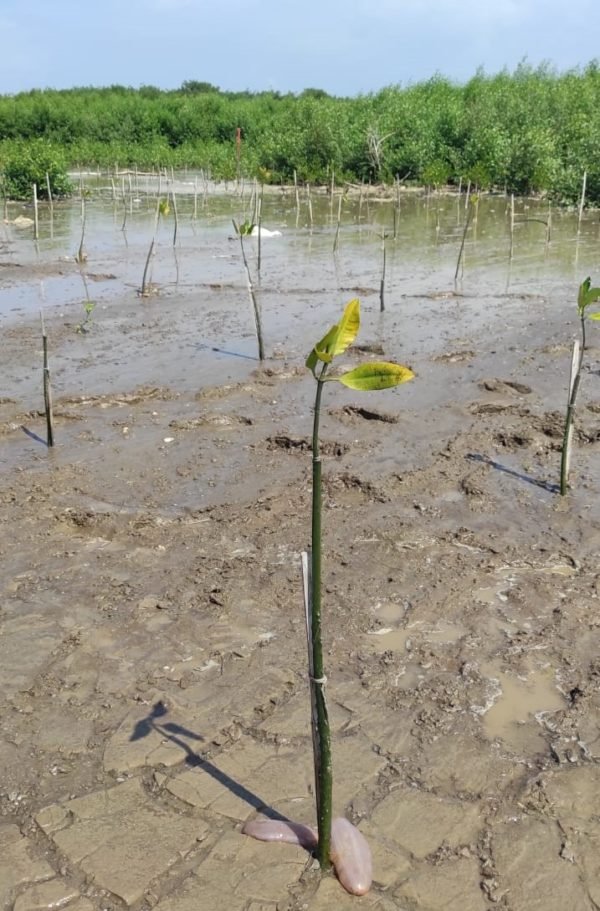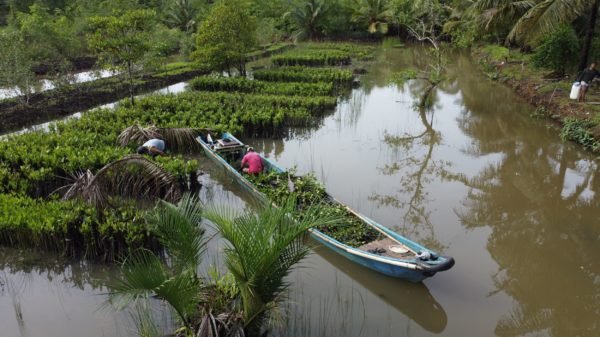
Kalirejo Art and Cultural Festival: Giving Thanks to Nature

Parade Festival Budaya Kalirejo_Trees4Trees
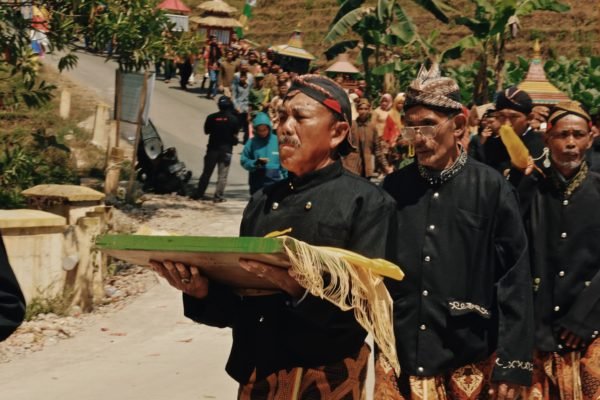
Kalirejo Art and Cultural Festival Parade. Photo: Trees4Trees/Yulianisa Dessenita

The fertile, volcanic soils of Central Java provide food and livelihoods for the many people who live off the land. In return, these communities give their thanks to nature with offerings and elaborate celebrations. One of these festivals was held recently in a Trees4Trees operation area – Kalirejo Village in Kebumen.  

From August 9–11, the Kalirejo Art and Cultural Festival combined cultural traditions with religious ceremonies, in a show that proudly affirmed the community’s identity. The celebrations included performances of traditional dance, a cultural parade, games, and a shared feast.  
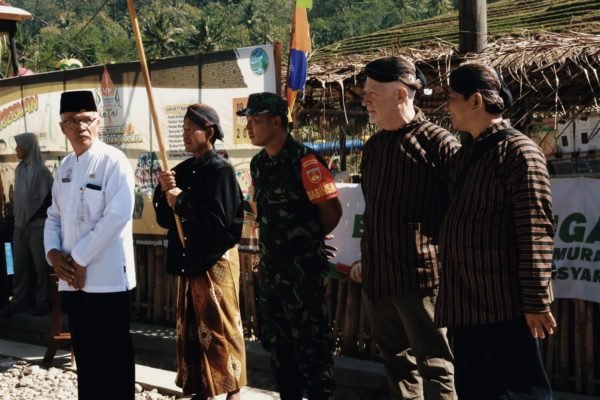
Trees4Trees join the celebrations at Kalirejo Art and Cultural Festival
(Above) Trees4Trees join the celebrations at Kalirejo Art and Cultural Festival

Connection to land and ancestors 

The event showcased a series of performances, including the cepetan and ebeg. Passed down through the generations, these traditional dances have a mystic quality, and connect the dancers to the spirits of their ancestors. 

The festival also featured a performance of the wayang kulit (a traditional Javanese shadow puppet show) as part of the ruwat bumi – a traditional ceremony that aims to secure the peace, security, and prosperity of the village.  

Cepetan dance performed at Kalirejo Art and Cultural Festival_Trees4Trees
(Above) Cepetan dancers wear devil masks to scare evil spirits away from the village. (Below) The ebeg dance features horse-like effigies made from woven bamboo. It symbolizes the bravery of soldiers going to war.

Ebeg dance performed at Kalirejo Art and Cultural Festival_Trees4Trees

Keeping tradition alive  

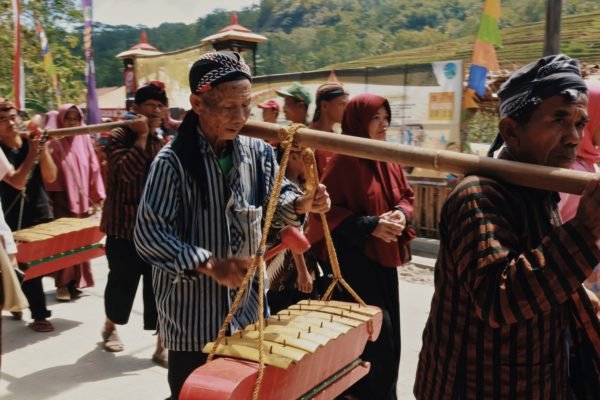
The celebrations came to a climax with a colorful parade, in which the whole community came together to watch or take part. Villagers proudly carried their produce from the fields, which included corn, rice, fruits, vegetables, and tubers. Accompanying the parade were dancers and musicians, who helped create a carnival atmosphere. 
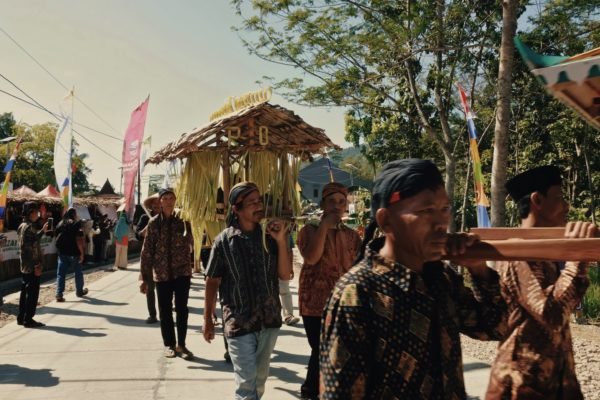
 Villagers carry their produce during the parade
(Above) Villagers carry their produce during the parade.  (Below) A convoy of musicians and dancers help create a carnival atmosphere.

 (Below) A convoy of musicians and dancers help create a carnival atmosphere

Next came the kenduri giling pitu feast, which involves villagers placing rice and vegetables wrapped in banana leaves onto woven trays. After offering prayers and giving thanks for the bountiful harvest, the food is distributed to all in attendance at the festival.  

According to Ella, a local Trees4Trees Field Coordinator who was born and raised in Kebumen, “the prayers and the distribution of food symbolize the villagers’ gratitude to both God and nature.” 
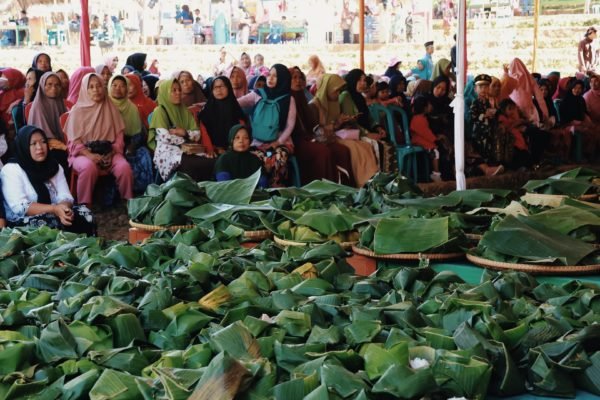
The kenduri giling pitu feast at Kalirejo Art and Cultural Festival

The traditions of art, music, dance, and traditional ceremonies highlighted by the Kalirejo Art and Cultural Festival dates back centuries. However, some of the village elders are concerned that, unless the younger generation keep them alive, these pastimes may soon fade away. 

“The festival is a way to preserve our ancestral culture, ensuring it stands the passage of time,” says Maratun Chasanah, a Trees4Trees Field Coordinator and a local youth from Kebumen. “This way, the young generation can gain a deeper understanding of their own traditions and arts,” she added. 

A cup of Java: Growing the local economy 

Cultural preservation was not the only aim of the festival. The community also set up a bazaar where villagers could sell their products, which included traditional foods made from crops like cassava and corn, handmade crafts from woven bamboo, fresh fruit and vegetables, and the village’s new up-and-coming commodity: Coffee.  

Together with Tree Ltd, Trees4Trees has been helping local communities in Kalirejo plant coffee trees since 2019. And these activities are already delivering positive results. 

“We harvested approximately one ton of coffee from the trees provided by Trees4Trees and Tree Ltd,” says Sarman, the Head of Kalirejo Village. “This valuable commodity has significantly supported our community, and we eagerly anticipate the continuation of this collaboration,” he added.  
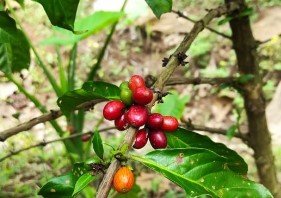
Ripe coffee cherries add color to the fields in Kalirejo
(Above) Ripe coffee cherries add color to the fields in Kalirejo

Read also:

Rasito, Optimizing His Land with Coffee Trees

The Story of Wasis, How a Tree Grower is Making a Difference in Water Conservation 

Planting the seeds of new traditions 

During the festival, Trees4Trees distributed seedlings and organic fertilizer, to support reforestation and promote the adoption of organic farming in Kalirejo. A total of 1,000 trees were distributed to festival attendees,. including suren, duku, gayam, clove, and coffee. 

“Suren leaves can be used as biopesticides, coffee offers a stable income from its berries, and Gayam trees assist in soil and water conservation,” explains Rizky Pradhitya, Trees4Trees’ Unit Manager in Kebumen. 

“We believe that by providing these seedlings we can showcase the trees’ potential to the community – our aim is to help them improve their environment and promote organic agriculture, while also boosting productivity, so everybody wins.”  
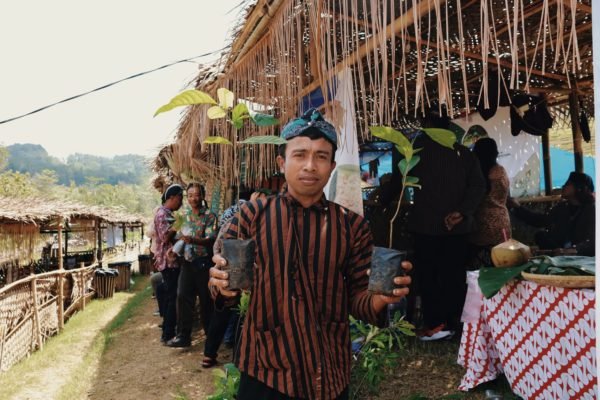
Two of the 1,000 seedlings distributed to Kalirejo by Trees4Trees and Trees Ltd

Writer: V. Arnila Wulandani. Editor: Christopher Alexander

Ayi: Preserving Water Sources Through Tree Planting

Ayi, a tree grower from Drawati Village Bandung_Trees4Trees
Preserving Water Sources Through Tree Planting
Ayi, a tree grower from Drawati Village Bandung_Trees4Trees

Drawati Village, nestled in Paseh District, Bandung Regency. This hillside community rests close to an upstream river—a tributary of the Citarum river watershed. As a result, vital springs dot the area, serving as crucial water sources for the local populace’s daily needs. 

Given the significance of the existing springs, safeguarding the surrounding environment becomes imperative. The preservation of water sources requires rehabilitation and reforestation efforts. To this end, the Drawati village government has been actively promoting reforestation activities among its residents through socialization and various programs. 

Trees4Trees Tree-Planting Program Contributes the Water Spring Conservation 

When the Trees4Trees team introduced a tree planting program funded by AstraZeneca in collaboration with Trees4Trees and One Tree Planted, both the village government and the villagers responded positively. This initiative aligned well with the village’s mission to advance reforestation efforts. 

Later, the tree planting program gained the participation of farmer groups in the village, composed of individuals dedicated to reforestation endeavors. Among these farmers, Ayi emerged as the best farmer of Drawati village due to his unwavering commitment to tree planting and reforestation. Ayi’s accomplishments are a testament to his long-standing dedication to his environment. 

Prior to joining this tree planting initiative, Ayi was actively engaged in reforestation activities alongside fellow villagers. He pointed out that accessing clean water in his village has become increasingly challenging, despite its proximity to the river’s source. This challenge fueled his determination to revitalize the village’s surroundings, ensuring a more abundant flow of water. He also aspires to enhance underutilized lands through increased tree planting. 

Ayi, a tree grower from Drawati Village Bandung is taking care of his trees_Trees4Trees

Planting Trees to Rejuvenate the Environment and Anticipate the Fruitful Yield 

“I plant trees for a better life and a brighter future for this village, not just for myself and my family, but for the entire community. Most importantly, it’s about nurturing a healthy environment around the village” Ayi said.  

He also revealed that many lands around his village are suffering and have been faced a shortage of clean water. This drives his motivation to plant more trees, hoping to rejuvenate our surroundings and ensure the abundant flow of water.  

“Water is a fundamental necessity for human life, making this endeavor worth every effort,” Ayi expressed. 

Furthermore, Ayi emphasized that tree planting not only fosters a healthier environment but also yields fruitful crops. When he joined the tree planting program, Ayi opted for jabon trees (burflower-tree) due to their rapid growth compared to other tree species. 

In addition, Ayi cultivated food crops such as corn, cassava, and various fruits, including orange trees. 

“I’ve also planted orange trees, anticipating a fruitful yield in the future. My aim is to harvest these crops. Planting trees holds immense benefits – it adds greenery to the environment and allows me to save for my future by selling the crops,” Ayi shared. 

Ayi, a tree grower from Drawati Village Bandung with head of village_Trees4Trees
Ayi was visited by Drawati Head Village dur to his dedication in reforestation and water sources preservation efforts.

Recognized for the Environmental Conservation Efforts 

Due to the unwavering dedication to tree planting and reforestation, Ayi and the farmer groups were acknowledged and commended by the head of Drawati Village. According to the village head, the present era mandates a life philosophy centered on nature preservation, as nature has nurtured and sustained us. Therefore, it is our responsibility to reciprocate this care. Ayi and the farmer group’s actions stand as a commendable example in this regard. 

“Greening initiatives contribute to the preservation and conservation of water, a crucial element for sustaining human life. We must prevent our water sources from depleting. We must ensure that our future generations do not shed tears due to a lack of springs. Let us unite to prevent such a future!” emphasized the village head during his encounter with Ayi and the farmer group of Drawati Village. 

Activity Highlights: Ensuring the Data Accuracy through Data Collection

Scanning planting location barcode through GEKO App_Trees4Trees

Our field team is currently in the process of data collection, a crucial stage within Trees4Trees tree-planting operation. This phase is dedicated to gathering accurate data, photographs, and essential information about our farmer partners as the tree growers and the designated planting locations. 

During this stage, our proprietary GEKO app is employed as a digital tool, allowing us to precisely document the farmers and planting locations. This technology is integral to our commitment to transparency and delivering accurate reports to our donors and sponsors. 

Witness our data collection efforts across various operational regions through the images provided below! 

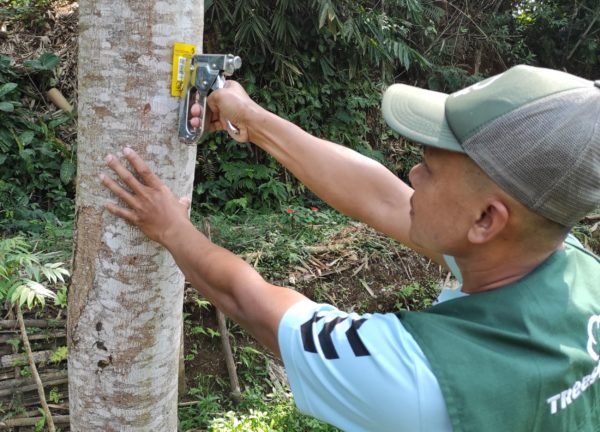
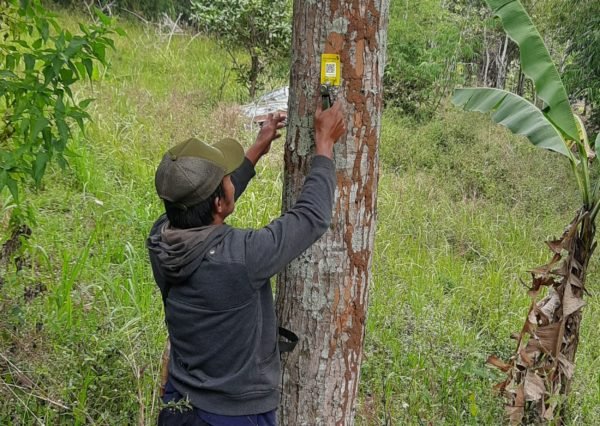
In the Trees4Trees Cirasea 3 site, our team is attaching barcodes in Pangauban Village, Bandung Regency

To identify the tree-planting sites, our field team affixes barcodes in each farmer’s field. In the Trees4Trees Cirasea 3 site (above), our team is attaching barcodes in Pangauban Village, Bandung Regency. Similarly, in the Trees4Trees Citarik site (below), our team is applying barcodes in Dampit Village, Bandung Regency. 

Scanning planting location barcode through GEKO App_Trees4Trees

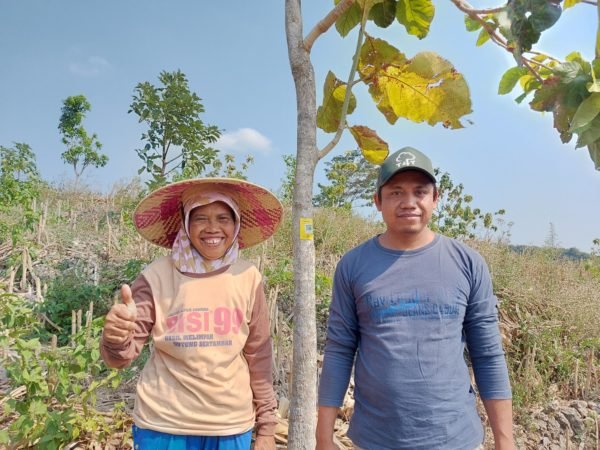
The barcode has been successfully affixed to a tree in the field of one of our farmer partners in Beketel Village, Pati, Central Java_Trees4Trees

The barcode has been successfully affixed to a tree in the field of one of our farmer partners in Beketel Village, Pati, Central Java. This barcode serves to identify the specific tree-planting location on the farmer’s land. 

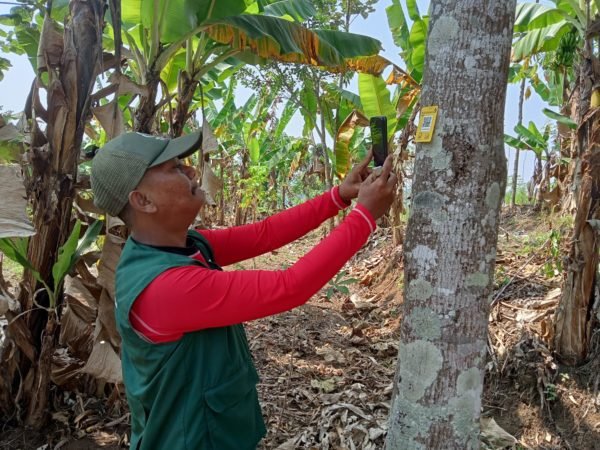
 team members at the Ciminyak 2 site is currently scanning the barcode in Mekarsari village, West Bandung_Trees4Trees

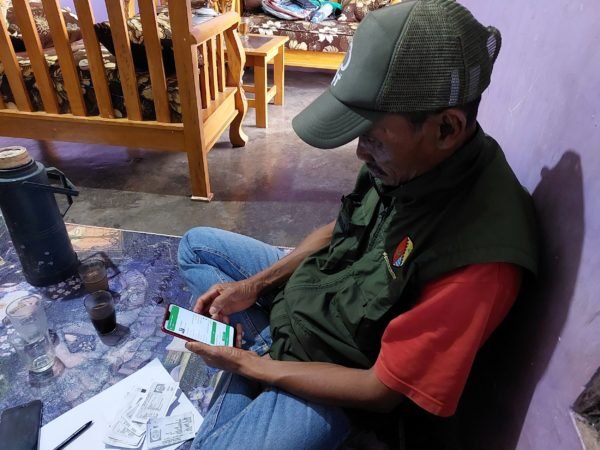
After attaching the barcode, our team will scan it using the GEKO app on a smartphone. This process collects accurate location coordinates for the designated planting site. One of our team members at the Ciminyak 2 site is currently scanning the barcode in Mekarsari village, West Bandung Regency. 

Trees4trees team at the Cisangkuy site engaged in discussions with the farmer_Trees4Trees

After affixing the barcode to a farmer’s planting location in Malasari village, Bandung Regency, our team at the Cisangkuy site engaged in discussions with the farmer who owns the field. This process involves finalizing the land’s data. 

Trees4Trees team at the Cirasea 2 site is currently enroute to collect data on planting locations_Trees4Trees

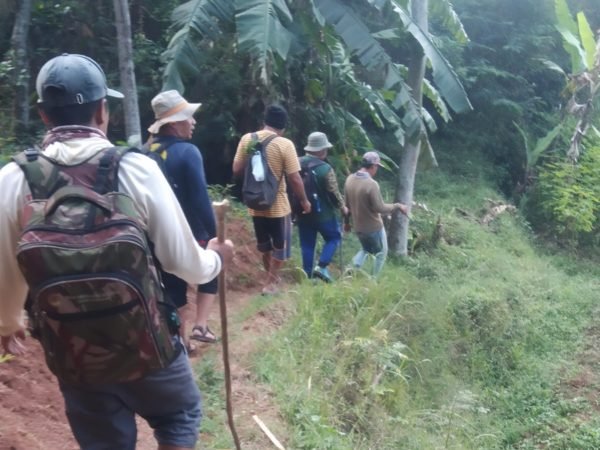
Reaching the planting locations and gathering precise data isn’t an easy task. At times, the tracks are challenging, featuring rocky and steep terrain. Our team often has to traverse these paths for hours. Together with farmers and local residents, our team at the Cirasea 2 site is currently enroute to collect data on planting locations. 

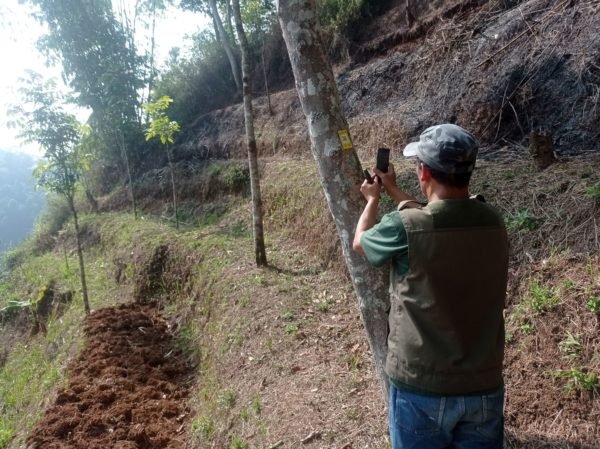
Trees4Trees team at the Ciminyak 3 site is capturing a barcode that has been affixed to one of the planting locations_trees4trees

Our team at the Ciminyak 3 site is capturing a barcode that has been affixed to one of the planting locations. Some of these planting sites feature steep inclines and are susceptible to erosion. This emphasizes the importance of planting more trees in these areas to mitigate the risk of landslides and erosion. 

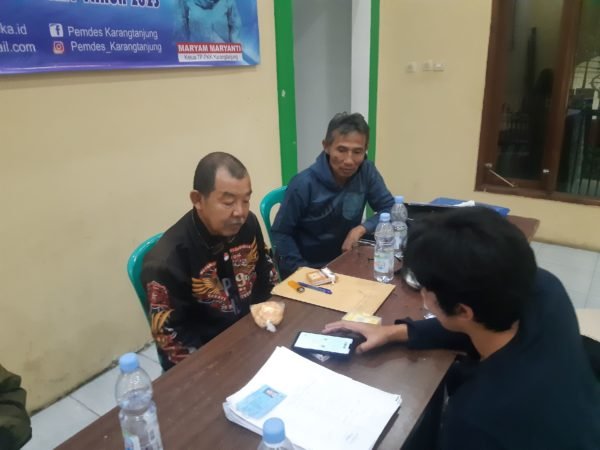
The team in Kebumen is verifying farmers' data_trees4trees

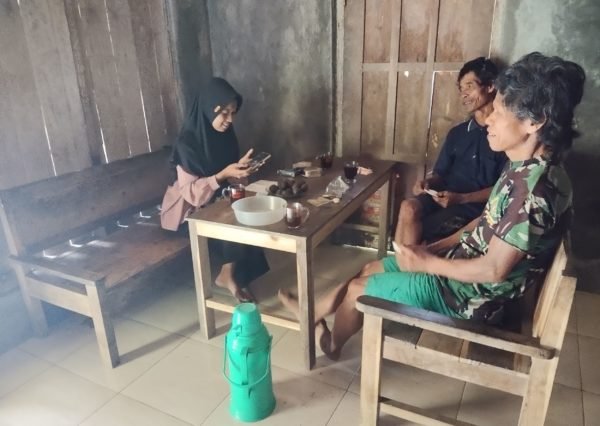
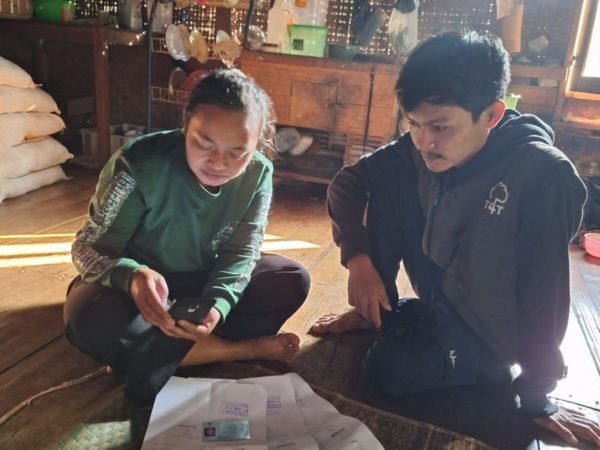
In addition to gathering planting location data, our field team is also tasked with collecting data from the farmers. The team in Kebumen (above) and at the Ciminyak 1 site (below) is verifying farmers’ data by conducting in-person meetings and interviews related to their identity and land data designated for planting areas. 

The team in Kebumen is verifying farmers' data_trees4trees

Trees4Trees team in Ciwidey inputs the data from Sukamulya village into the GEKO app

After gathering the farmers’ data, including identity documents and self-photographs of the farmers, our team in Ciwidey inputs the data from Sukamulya village into the GEKO app. 

Our team in Cirasea 1 is inputting farmers’ data into the GEKO app. Through technology, we record the data of farmers, planting locations, and all living trees. This information will be integrated with our website to display them on a digital map accessible to our supporters. This serves as a gesture of appreciation for their commitment to tree planting with us.  


Nursery Highlights: Witness the Flourishing Journey of Seedlings

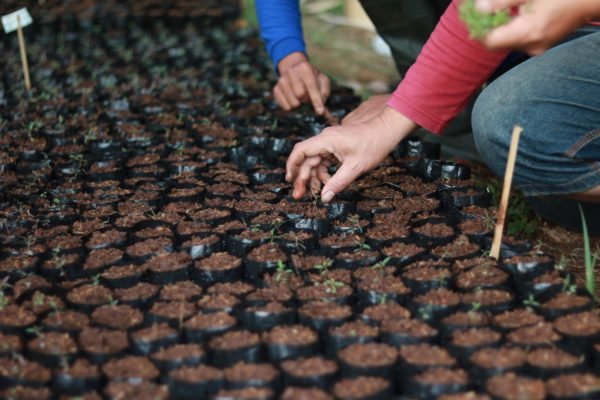
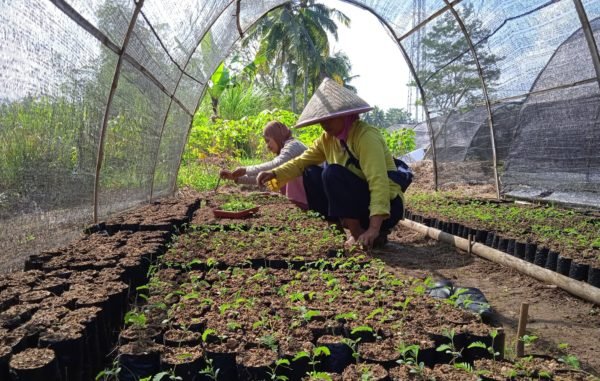
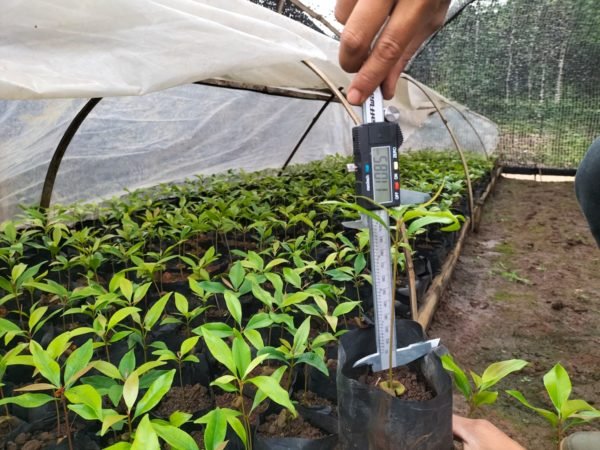
In the preparation for the 2023 planting season, all Trees4Trees’ nurseries in Central and West Java are bustling with activity as we nurture various kinds of tree seedlings, ranging from timber to fruit trees. Our dedicated nursery teams are working diligently to produce high-quality seedlings, reflecting our unwavering commitment to provide high-quality seedlings. 

One of our key priorities is to cultivate the tree seedlings using organic farming techniques. It aims to ensure that they are environmentally friendly. By adopting sustainable practices, we aim to contribute to a greener and healthier ecosystem. 

Observe the journey of nurturing these seedlings until they flourish into young trees. Take a glimpse into Trees4Trees’ nurseries through the captivating images below! 

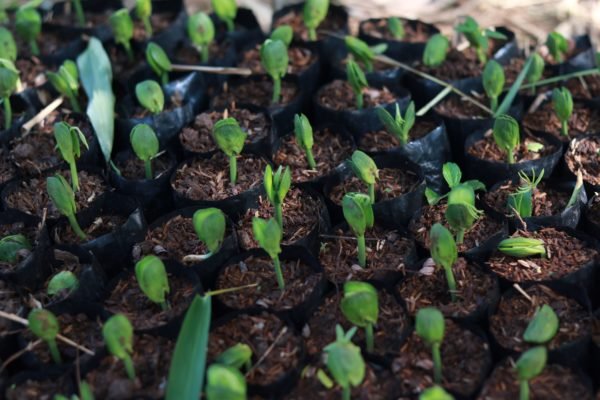
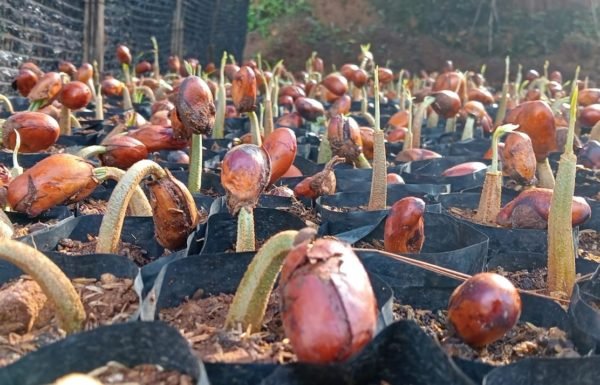
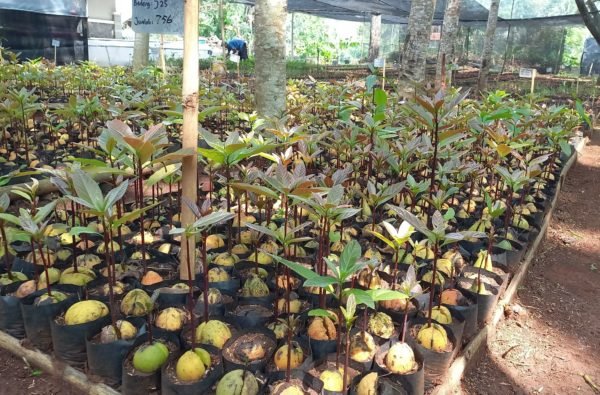
The Petai (Stinky Beans) seedlings, one of native Indonesia trees, are now beginning to grow into young trees at our newest nursery, Soreang Nursery. Our team cultivates these seedlings using the direct sowing or polybags method. It is a method where the fruit seeds are placed directly into polybags filled with planting media. Our team applies this particular method typically to trees with larger seeds. Other than petai, our team in West Java has also cultivates avocado, durian, coffee, and clove with this method. Meanwhile, in Trees4Trees Central Java, our team applies the method to avocado, durian, jack fruit, and petai. 

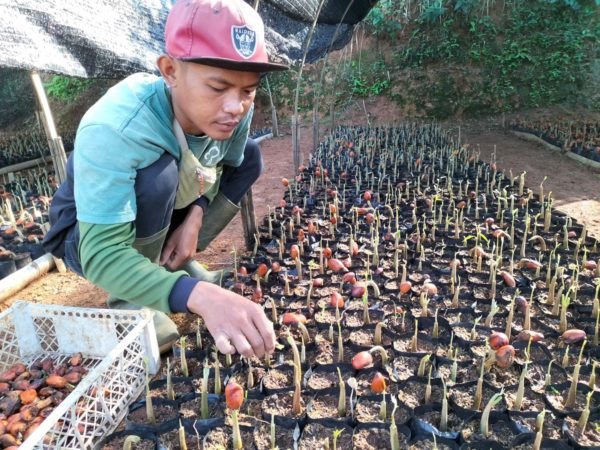
Similarly, the Durian, another native tree of Indonesia, is undergoing cultivation using the direct sowing or polybag method. Excitingly, at our Ciminyak nursery, the durian seedlings have already exhibited impressive growth, with their stems reaching new heights!  

As the durian seedlings progress in their growth journey, the seeds, known as durian ‘seedlings’ heads’ naturally detach from the stems and require removal. Recently, the dedicated nursery team at Ciminyak nursery was diligently engaged in cleaning the durian seedlings, carefully removing the detached ‘heads’ from the growing stems. 

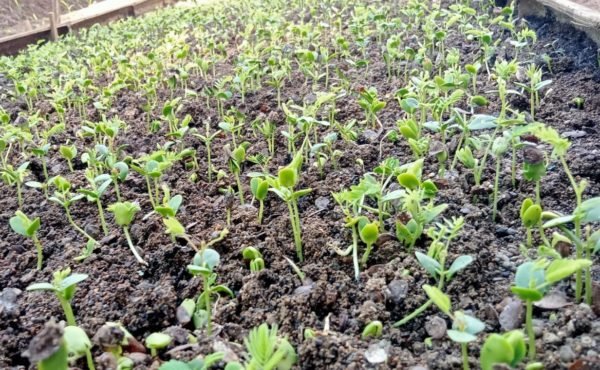
In addition to the direct sowing method, we also employ the indirect sowing or tray sowing method to cultivate seedlings. This involves germinating seeds in sowing trays or tubs, which is especially suitable for trees with small seeds. Typically, they need around five to 22 days (about 3 weeks) before our team transfers them to polybags. At Trees4Trees Kebumen nursery, our dedicated team is currently germinating kaliandra seeds, and we are delighted to witness their successful emergence and growth. In addition to kaliandra, our team applies this method to indigofera and sengon trees. 

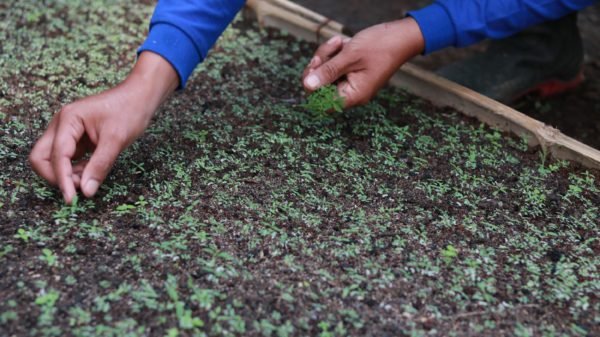
Our nursery team at Soreang Nursery is in the process of weaning the baby eucalyptus trees from the sowing tray. Similar to kaliandra, our team cultivates these seedlings using the indirect sowing or tray sowing method. Once the seedlings have grown into baby trees, they require careful weaning and transfer to individual polybags. In the West Java area, our team has applied this method to manglid, gmelina, eucalyptus, sengon, and suren. 

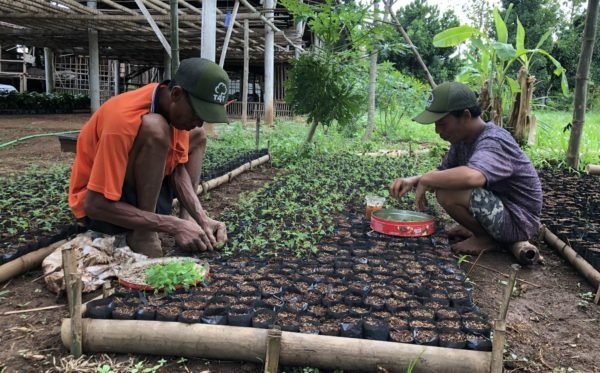
Upon completing the weaning process, the nursery team will proceed to transfer the seedlings from the sowing trays to individual polybags. It is the next phase of growth. After one month, our nursery team will carefully select the seedlings. The selection is based on their height and then grouped together in the same blocks. 

The Trees4Trees Kebumen nursery team (above) and the Pati nursery team (below) are actively engaged in transferring the kaliandra seedlings from the sowing trays to individual polybags. 

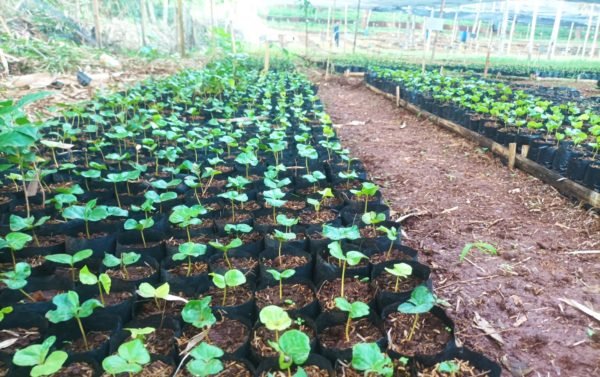
The avocado seedlings (above) and coffee seedlings (below) at Cirasea nursery are flourishing, steadily reaching new heights. Avocado and coffee trees stand among the most sought-after choices for our tree growers. 

Witness the Flourishing Journey of Seedlings

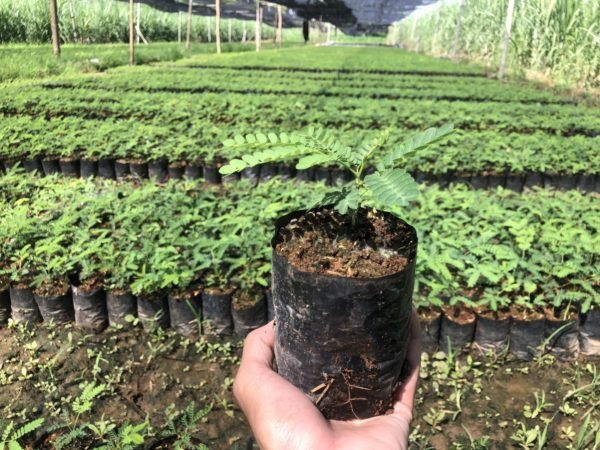
Sengon remains the most highly sought-after timber tree among our tree growers. In Trees4Trees Pati nursery, the young sengon trees are beginning to thrive, displaying vibrant green growth. 

Witness the Flourishing Journey of Seedlings

Restoring Mangroves in Cilacap, Central Java

Restoring Mangroves in Cilacap, Central Java
Photo: Trees4Trees/Haryadi

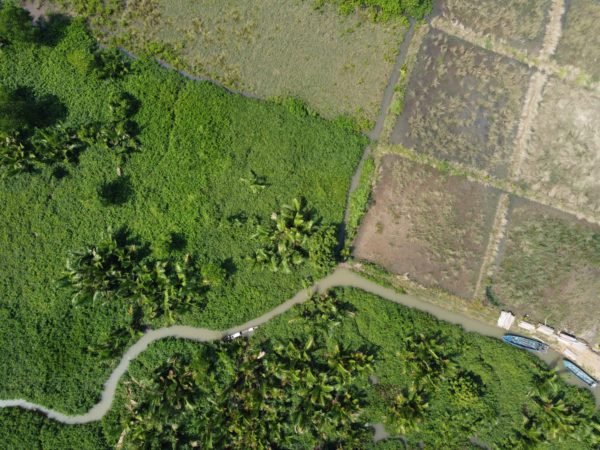
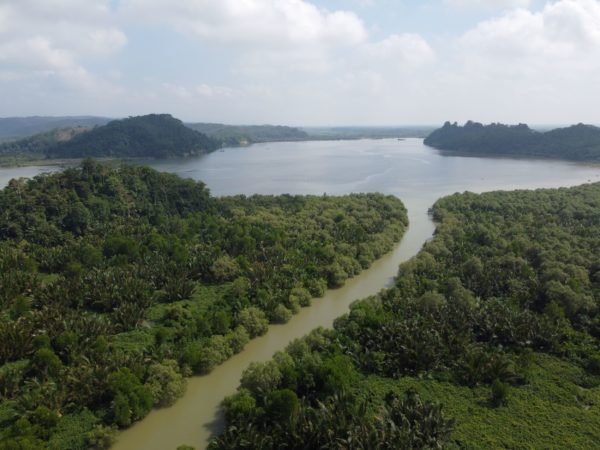
Located close to Segara Anakan lagoon in Java’s Cilacap Regency, Ujung Alang Village was once covered in mangroves. In the 1990s, the region experienced massive deforestation, mostly because of land being converted for aquaculture ponds. 

In the last two decades, local residents have been helping the mangroves bounce back. A conservation area has been set up and has since become a hub for studies and research into the natural world.  

Now, with support from Trees4Trees, mangrove restoration in Cilacap is going up a gear. An ambitious new replanting project has provided the investment and manpower needed to give the ecosystem a new lease of life. 

Healing the wounds of the past 

Before 1994, Ujung Alang and was covered with mangrove forests. These trees were then cleared by investors to make way for shrimp and milkfish ponds. This venture lasted just four years; by 1998, the ponds had been abandoned.,  

Virtually overnight, the investors cut their losses and left town. But not before leaving their mark on the landscape. Thousands of hectares of mangrove forests had been cut down and turned into barren land.  

In 2000, local communities decided to act, and made a plan to restore the mangroves to their former state.  

Restoring mangrove in Ujung Alang Cilacap
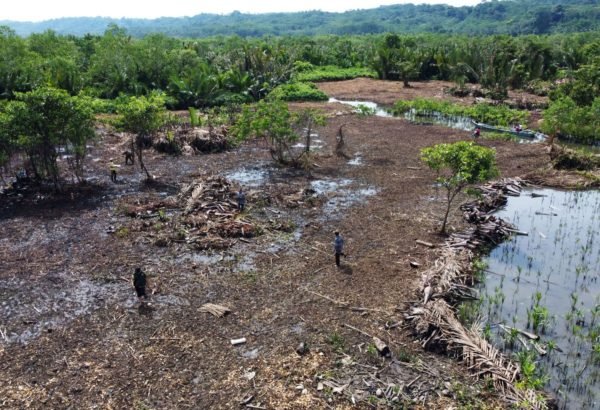
(Above) Abandoned shrimp ponds, overgrown with weeds. Photo: Trees4Trees/Haryadi

Working together to restore mangroves 

Over the past decade, local communities, with the support of the government and various other supporters, have successfully planted 56 different species of mangroves in an area covering approximately 400 hectares. Trees4Trees has committed to supporting these ongoing efforts. 

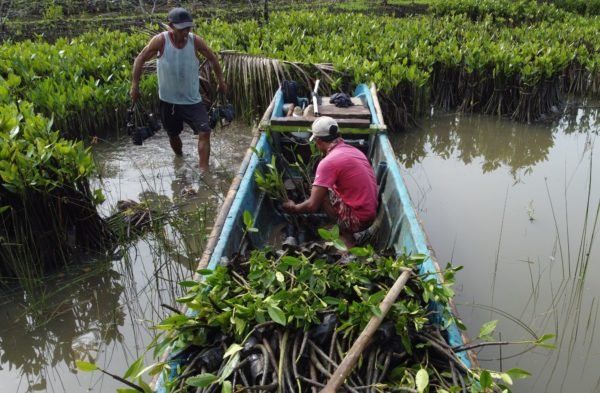
In early 2023, working in collaboration with the Tani Krida Wana Lestari farmer group, Trees4Trees began replanting an area of 2.4 hectares around Ujung Alang. So far, we have planted more than 7,600 trees together. 

Planting mangrove in Ujung Alang Cilacap
(Above) Segara Anakan Lagoon. Photo: Trees4Trees/Kemas Duga Muis

“Deforestation of mangrove forests in Segara Anakan has led to a significant reduction in mangrove area and caused a decline in fish catches,” explains Armin Agung Mubarok, the Trees4Trees Impact Officer and coordinator of the mangrove project. “By restoring the mangrove ecosystem, we aims to restore the habitat as a nursery ground for crustaceans and other animals, thereby enhancing biodiversity in the region,” he added. 

Haryadi is the Trees4Trees GIS officer on the project., He experienced a number of challenges in clearing away the old growth to make way for new mangroves. As he explains, “clearing the areas of weeds is crucial, as they hinder the growth of the mangroves.”  

Planting mangrove in Ujung Alang Cilacap
(Above) Invasive weeds are cleared before replanting can begin. Photo: Trees4Trees/Haryadi

Restoring natural balance to the ecosystem  

After the weeds had been cleared, Trees4Trees focused on planting four different mangrove tree species, each one chosen to match the unique conditions of their environment.  

In areas less affected by the tide, large-leafed orange mangroves (Bruguiera gymnorrhiza) were chosen, due to their ability to thrive in areas where there’s not much saltwater. They can also do well in both shady and sun-baked areas. 

In tidal areas that are regularly flooded, tall-stilt mangroves (Rhizophora apiculate) were planted, as they thrive in wet, muddy soil. Red mangroves (Rhizophora mucronata) were chosen for inundated areas, where they can grow and thrive. 

Finally, seedlings of spotted mangroves (Rhizophora stylosa) were planted throughout the area, to improve the diversity of species.  

Planting mangrove in Ujung Alang Cilacap
(Above) Working together with local communities, Trees4Trees replants the mangrove forest. Photo: Trees4Trees/Haryadi

Next steps: Taking replanting to the next level 

This small-scale pilot project, was an opportunity to test out planting methods before launching a more ambitious program. Over the next five years, Trees4Trees intends to scale up these efforts and continue planting mangroves to restore mangrove cover.  

“Based on the trial we conducted, we were able to plant 3,500 trees per hectare,” says Haryadi, who is working to turn initial impact into long-term reforestation. “Over the next few years, our goal is to plant mangroves over an area of 1,000 hectares.

Writer: V. Arnila Wulandani. Editor: Christopher Alexander

Blue Carbon: Coastal Forests on the Frontline of Climate Change

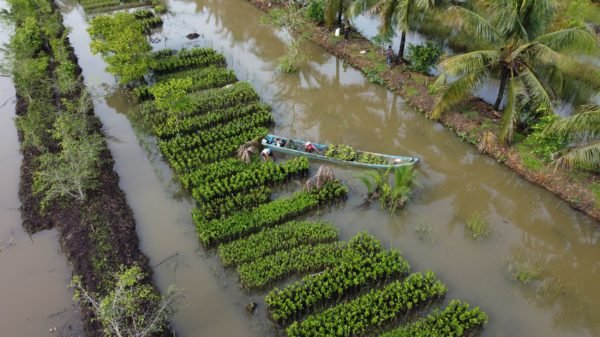
A Trees4Trees mangrove project planted in 2021


Photo: Trees4Trees/Yulianisa Dessenita

How can we combat global warming? Planting trees is a good place to start. Forests are the lungs of our planet. They produce oxygen and absorb the emissions we produce, while also keeping potentially harmful carbon in the ground, where it belongs. 

But when you think of forests, you probably don’t think of coastal and marine ecosystems, right? And yet, these ecosystems store more carbon than anywhere else on Earth. Carbon absorbed and stored here is called “blue carbon”. And blue carbon could be the key to a greener future.  

What is blue carbon and why is it important? 

Blue carbon is the carbon stored in coastal and marine ecosystems. Most of it is carbon dioxide (CO2) that has dissolved directly into the ocean. Lots of blue carbon is stored in underwater sediment, coastal vegetation, and coastal soils. 

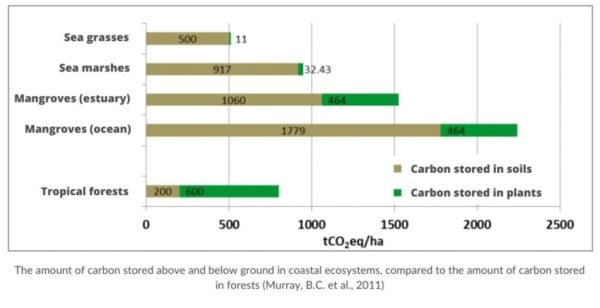
Coastal ecosystems can be sea grasses, mangroves, and salt marshes. They all play a crucial role in capturing and retaining carbon. It is for this reason that they’re sometimes called ‘carbon sinks. Although coastal ecosystems are smaller than terrestrial forests, they actually  sequester and store more carbon. 

Unlike in tropical forests, where carbon is stored in above-ground plants, blue carbon is stored below the ground., Some blue carbon can be thousands of years old.  

Did you know? Coastal ecosystems store more carbon per hectare than terrestrial forests. 

A Trees4Trees mangrove project planted in 2021
(Above) A Trees4Trees mangrove project planted in 2021. Photo: Trees4Trees/Yulianisa Dessenita

Coastal ecosystems: Our first line of defense 

Every year, mangroves and coastal wetlands suck ten times more carbon out of the atmosphere than tropical forests. They also store three to five times more carbon.  

When these habitats are damaged or destroyed, all that carbon is released into the atmosphere as harmful greenhouse gases. This makes protecting and restoring coastal habitats essential to combating climate change.  

Healthy coastal ecosystems give us loads of other benefits besides carbon. They offer protection from storms and erosion, provide nurseries for commercial fisheries, and are beautiful places for us to explore and enjoy. 

Did you know? Coastal habitats make up less than 2% of total ocean area, but store around 50% of the carbon sequestered in ocean sediments 

Carbon stored in mangroves ecosystem comparation
The graphic is modified from the original source IUCN

Coastal ecosystems in Indonesia 

In case you didn’t know, Indonesia is huge. This enormous archipelago is home to nearly a quarter of the world’s mangroves, which cover about 3.2 million hectares.

Together with 3 million hectares of sea grasses, these areas store about 3.4 billion metric tons of carbon – that’s 17% of all the blue carbon in the world. 

But despite their massive importance, Indonesian mangroves are under serious threat. Every year, more of these areas are converted into ponds or swallowed up by urban expansion. 

Indonesia emits 190 million tons of CO2-eq every year. That’s 42% of the world’s annual emissions from the destruction of coastal ecosystem services. 

Read more: Five types of mangrove in Indonesia and their benefits 

Trees4Trees mangrove restoration program  

As part of our commitment to support the Indonesian government’s efforts to restore mangrove cover and preserve blue carbon stored in coastal ecosystems, Trees4Trees has been busy replanting mangroves in Central Java. 

A sea cucumber and mangrove seedling in Dukuhseti coastal area, Pati.
(Above) A sea cucumber and mangrove seedling. Photo: Trees4Trees/V. Arnila Wulandani

“From 2021 to 2022, we successfully planted more than 100,000 seedlings in seven coastal villages in Pati,” explains Khoirum Minan, Trees4Trees Pati Unit Manager. “We aim to prevent tidal surges that can erode shorelines and pose a threat to residential areas and fishponds owned by local communities,” he added

The benefits of Trees4Trees mangrove planting mission in Central Java can already be clearly seen. “Mangroves we planted in 2021 have formed a green belt,” says Mustofa, the farmer group leader in Dukuhseti village in Pati. The ecosystem has taken shape, and we often observe birds, fish, and crustaceans in these newly restored mangrove areas.”  
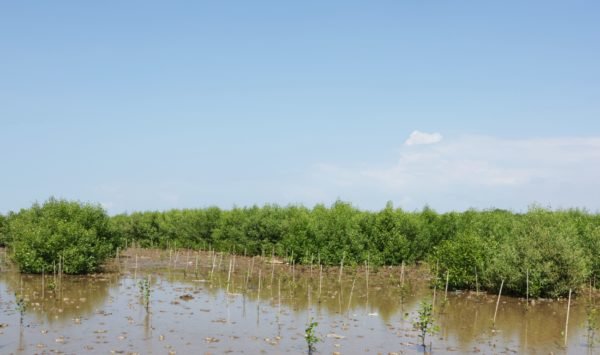
Did you know? It’s estimated that 83% of the global carbon cycle is circulated through the ocean. 

Elsewhere in Central Java, Trees4Trees recently planted 7,600 plants in an area of mangroves spanning 2.4 hectares in Segara Anakan, Cilacap., This previously degraded mangrove ecosystem is now thriving.  

This small-scale pilot project was a chance for us to try out our planting methods before the time came to tackle a bigger challenge. And that time has now arrived.  By 2027, Trees4Trees aims to plant 3.5 million trees in an area covering 1,000 ha in Cilacap, Central Java. 
Read more: Replanting mangroves rebuilding future in Central Java 

“Our project aims to restore the degraded mangrove ecosystems, enhance mangrove species diversity, promote fish populations and biodiversity, and eliminate invasive weeds that disrupt the mangrove growth,.” says Armin Mubarok, the Trees4Trees Impact Officer leading the mangrove planting program in Cilacap. 
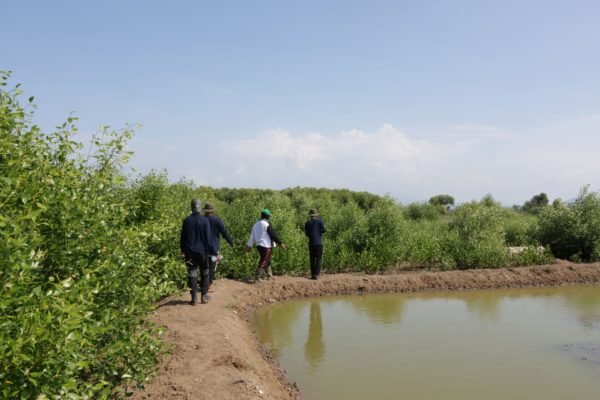
Mangrove planting in Cilacap
(Above) Mangrove planting in Cilacap. Photo: Trees4Trees/Haryadi

Through our mangrove planting efforts, Trees4Trees is working to restore degraded mangrove ecosystems and build new green belts along Indonesia’s precious coastlines.  

Together with our local partners, we’re working to preserve blue carbon, and provide lasting benefits to people and nature.  

Writer: V. Arnila Wulandani. Editor: Christopher Alexander